Mobile Harbour Crane Buying Guide: Capacity, Brands, Pricing & Inspection
A mobile harbour crane (MHC) is the most flexible piece of port equipment a port can own. It can handle containers, bulk, breakbulk, project cargo, and timber — often from the same berth on the same day. But flexibility comes at a price, and buying the wrong specification is a costly mistake that takes years to correct. This guide covers everything a buyer needs to evaluate before signing a purchase agreement.
What Is a Mobile Harbour Crane?
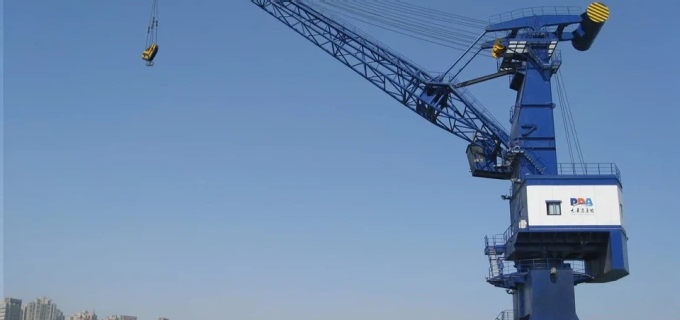
An MHC is a self-propelled, rail-free pedestal crane mounted on rubber tyres or a self-propelled undercarriage. Unlike a ship-to-shore (STS) crane, it is not fixed to a berth and can reposition between quays, terminals, or even between ports. Modern MHCs have outreach of 30–58 metres and lifting capacities ranging from 40 tonnes for smaller models up to 208 tonnes for high-capacity variants designed for project and heavy-lift cargo.
The crane typically consists of a slewing superstructure, a luffing or fixed jib, a rope hoist system, and a self-propelled carrier. The carrier may be wheeled (rubber-tyred) or rail-mounted in permanent installations, though most modern MHCs sold on the used market are rubber-tyred.
Capacity Ranges and Models
MHC capacity is expressed as lift capacity at a given radius. A crane rated "100 t at 40 m" lifts 100 tonnes with the hook at 40 metres outreach. As outreach increases, capacity drops — always verify the load chart, not just the headline figure.
| Capacity class | Typical use | Example models |
|---|---|---|
| 40–80 t | Smaller ports, breakbulk, general cargo | Liebherr LHM 180, Gottwald HMK 170 E |
| 80–120 t | Container handling, bulk terminals, feeders | Liebherr LHM 400, Gottwald HMK 280 E, Sennebogen 880 |
| 120–160 t | Large container and bulk, feeder + mainline vessels | Liebherr LHM 500, Gottwald HMK 330 E |
| 160–208 t | Heavy lift, project cargo, offshore support | Liebherr LHM 600, Gottwald HMK 6407 B |
MHC vs STS Crane: Key Differences
Buyers sometimes evaluate MHCs against ship-to-shore cranes for container operations. The comparison is relevant only for terminals that primarily handle containers, but it is worth understanding the trade-offs.
| Factor | Mobile Harbour Crane | STS Crane |
|---|---|---|
| Flexibility | Can reposition between berths; handles multiple cargo types | Fixed to one berth; container-only in practice |
| Throughput (containers) | 15–25 moves/hour with spreader | 25–40 moves/hour; twin-lift up to 60+ |
| Capital cost | €300k–€8M (used); €2M–€12M (new) | €8M–€25M (new); limited used market |
| Infrastructure required | Quay bearing capacity; no dedicated rail or runway | Dedicated rail, power supply, quay strengthening |
| Vessel size served | Up to Panamax; some post-Panamax with high outreach | Up to ultra-large container vessels (24,000 TEU+) |
| Maintenance complexity | Moderate; diesel-electric or fully electric | High; complex trolley, gantry, and hoist systems |
For terminals serving vessels up to Panamax size with mixed cargo, an MHC almost always makes more financial sense than an STS crane. For dedicated container mega-hub operations on post-Panamax vessels, STS cranes are the only realistic option.
Key Brands
Liebherr LHM Series: The benchmark for the industry. Liebherr's LHM range covers capacities from the LHM 180 up to the LHM 600 (208 t), with the flagship LHM 800 reaching 308 t. The LHM 400 and LHM 500 are the most common models on the used market. Liebherr cranes are known for reliability, excellent spare parts availability, and high residual value. They command a premium — typically 15–25% above comparable Gottwald models.
Gottwald / Konecranes HMK Series: Gottwald cranes (now branded Konecranes) are the main alternative to Liebherr. The HMK (Harbour Mobile Crane) series is a mature product line with a large installed base worldwide. Parts availability is good through the Konecranes network, and there is a strong used market. The HMK 280 and HMK 330 are particularly common in container operations.
Sennebogen: A German manufacturer offering the 8000 series MHC range. Sennebogen cranes are particularly strong in bulk and breakbulk handling and are popular in European inland and coastal ports. Less common in pure container operations. The Sennebogen 880 and 875 are commonly used in bulk and breakbulk port handling.
Pricing
Used MHC pricing covers an enormous range depending on capacity, age, brand, and condition:
- Small MHC (40–80 t), 15+ years old: €300,000 – €800,000
- Medium MHC (80–120 t), 10–15 years old: €800,000 – €2,500,000
- Large MHC (120–160 t), 5–10 years old: €2,500,000 – €5,000,000
- High-capacity or near-new (160 t+): €5,000,000 – €8,000,000+
Liebherr models at the top of each class will exceed these figures. A 2019 Liebherr LHM 550 in excellent condition can approach €6–7M. A comparable-age Gottwald HMK 330 in similar condition would typically be €4–5M.
Transport costs are significant — shipping an MHC between continents typically runs €150,000–€400,000 depending on destination, disassembly complexity, and port logistics.
Inspection Points Before Purchase
Never buy a used MHC without an independent technical inspection. Key areas to assess:
- Structural steelwork: Boom and jib condition, weld inspections, corrosion assessment. Fatigue cracks in boom sections are a red flag requiring expensive repair.
- Hoisting system: Wire rope condition and remaining service life, drum and sheave wear, hoist brake performance.
- Slewing ring and gear: The slewing ring is a major cost item (€80,000–€200,000). Check for uneven wear, play, and bearing noise.
- Diesel engine and power system: Engine hours, service records, emissions compliance for target port (Tier 3/Tier 4 requirements in EU and US ports).
- Control system: Age and type of PLC, availability of spare logic units, software version documentation.
- Travel system: Tyre condition and configuration, axle steering, propulsion unit service history.
- Load test: Insist on a witnessed load test at rated capacity before handover. No exceptions.
A mobile harbour crane is one of the most versatile pieces of port equipment you can buy, so take the time to match the specification to your cargo profile. Browse available mobile harbour cranes on Portneeds. For a detailed comparison of specific Liebherr models, see our LHM 400 vs LHM 500 comparison, read our mobile harbour crane FAQ.